-
1911
The Stroomers come to Prins Maurits
A year after Passer’s letter, the Stroomer family comes to Prins Maurits. From 1912 the family owns it, and runs the guesthouse, and later the hotel, for four generations.
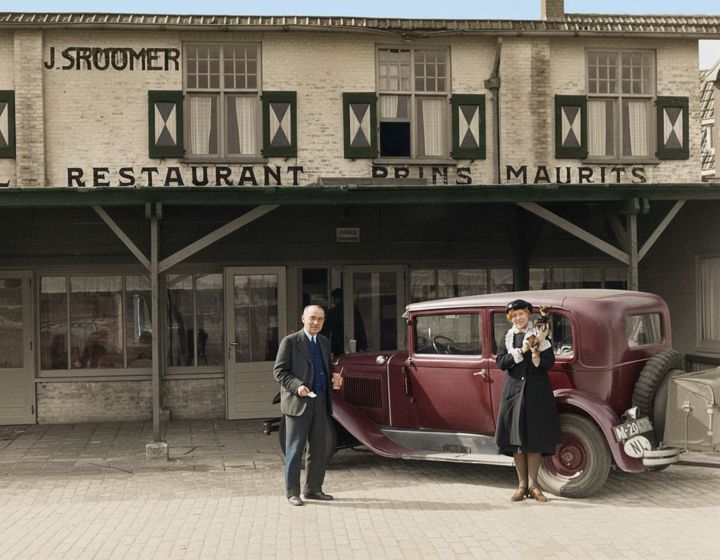
Restaurant Prins Maurits of J. Stroomer. 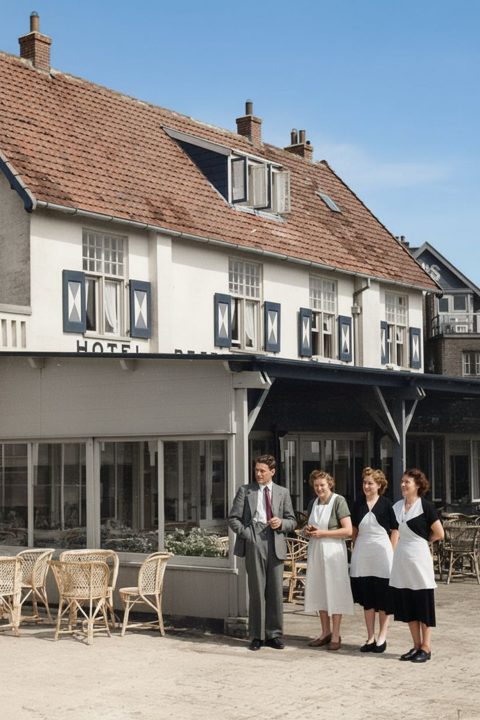
Staff in front of Hotel Prins Maurits. -
1912–1918
Willem Stroomer builds the village
With his brother he advertises as Gebr. Stroomer, “Contractors and Builders”, with one address on the Breelaan in Bergen and one in Bergen aan Zee: “Prins Maurits”. They draw up building plans and estimates, renovate and repair houses, sell and let plots, and offer building land “from 50 cents per m² and up”.
Carpenter and builder Willem Stroomer (1874–1946) puts up a large part of the young village: in 1912, for BEM, the post and telegraph office on the Van Hasseltweg (on opening day, 15 June, the poet Herman Gorter posted the first letter there), in 1913 the German children's home designed by Vorkink and Wormser, in 1914 the Dune Museum in the Parnassia park and, to a design by Maurits Plate, the Parkhuis with Theehuis Parnassia, in 1913 the children’s home of the Deutsche Hilfsverein (the Ferienkolonie), in 1914 the park keeper’s house in the Parnassiapark, in 1918 the Vredeskerkje (Peace Church), and Hotel Bakhuis on the Pier Panderstraat. From 1918 to 1944 he runs the former Pension Juliana on the Zeeweg as Hotel Stroomer. The Stroomerlaan in Bergen is named after him.
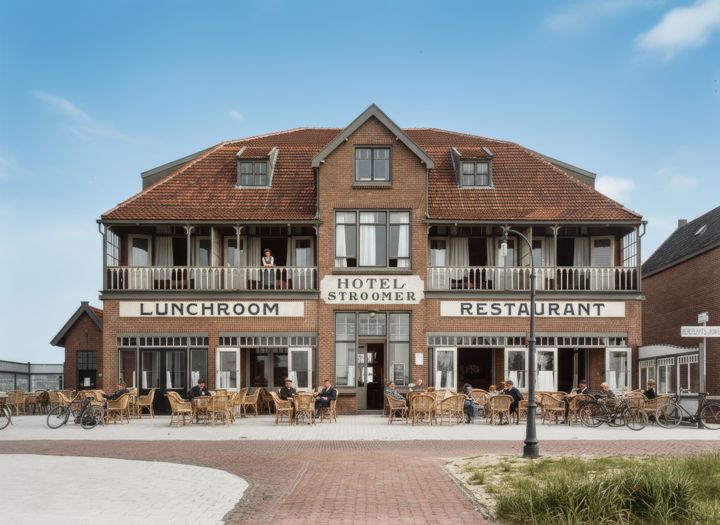
Hotel Stroomer on the Zeeweg, with lunchroom and restaurant. 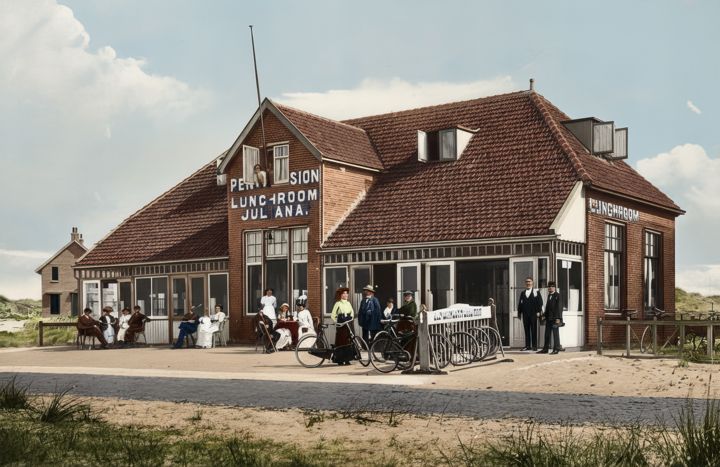
Pension Lunchroom Juliana on the Zeeweg, opened in 1909. From 1918 Willem Stroomer ran it as Hotel Stroomer. 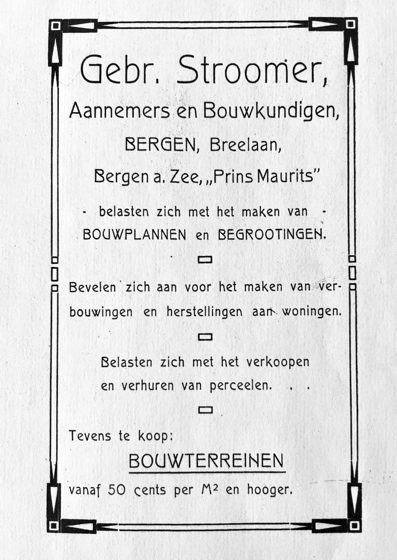
Advertisement for Gebr. Stroomer, with Prins Maurits as their Bergen aan Zee address. -
1918
The Vredeskerkje
Bergen aan Zee is a resort, but people need to be able to live there too, with everything that goes with it. A church is high on the wish list. On 9 February 1918 six-year-old Joachim Ernest van Panhuys, grandson of Jacob and Marie van Reenen, lays the first stone. The design is by Baron H.L. Taets van Amerongen and P. Elders; Willem Stroomer builds it.
On 28 July 1918, exactly twelve years after the first stone of Prins Maurits, the church is consecrated before some 150 guests by Bergen ministers Van den Kieboom and Creutzberg. It is a church for everyone: it belongs to no denomination, and both nave and tower are thatched with reed so that the building blends into the dunes. Marie van Reenen-Völter writes her own liturgy, modelled on the Église de l'Étoile in Paris. From the start Mees Ravenhorst and his wife are sexton and sextoness, later followed by their son Thijs; Cor Schotten helps with the Catholic services. All three also appear in the 1923 group photo.
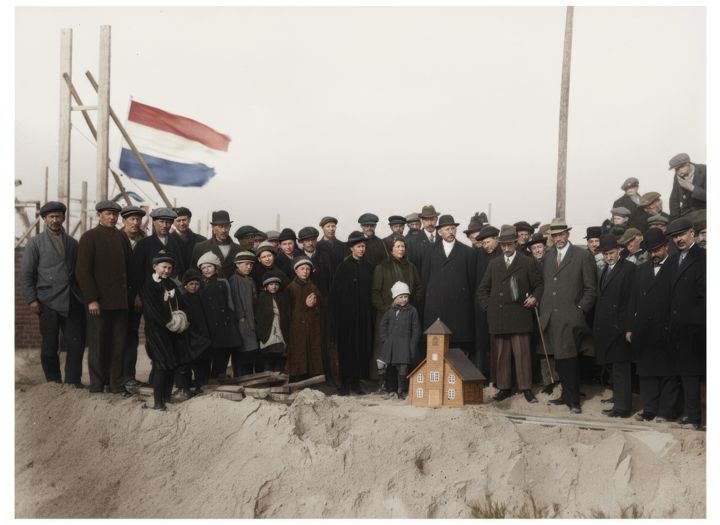
The laying of the first stone on 9 February 1918, with the model of the church. 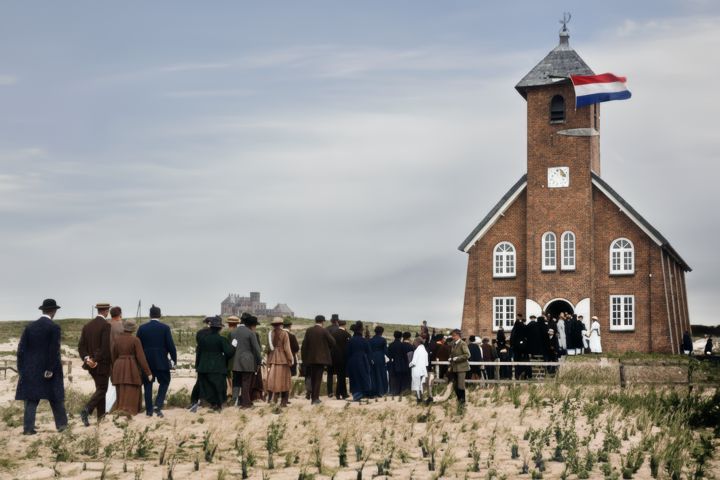
The opening of the Vredeskerkje on 28 July 1918. In the background Villa Russenduin. -
1923
Fifty residents
Bergen aan Zee is home to just a handful of families. This photo brings fifty residents together, among them Jacob, Willem, Jan, Dieuwertje, Alie and Marie Stroomer.
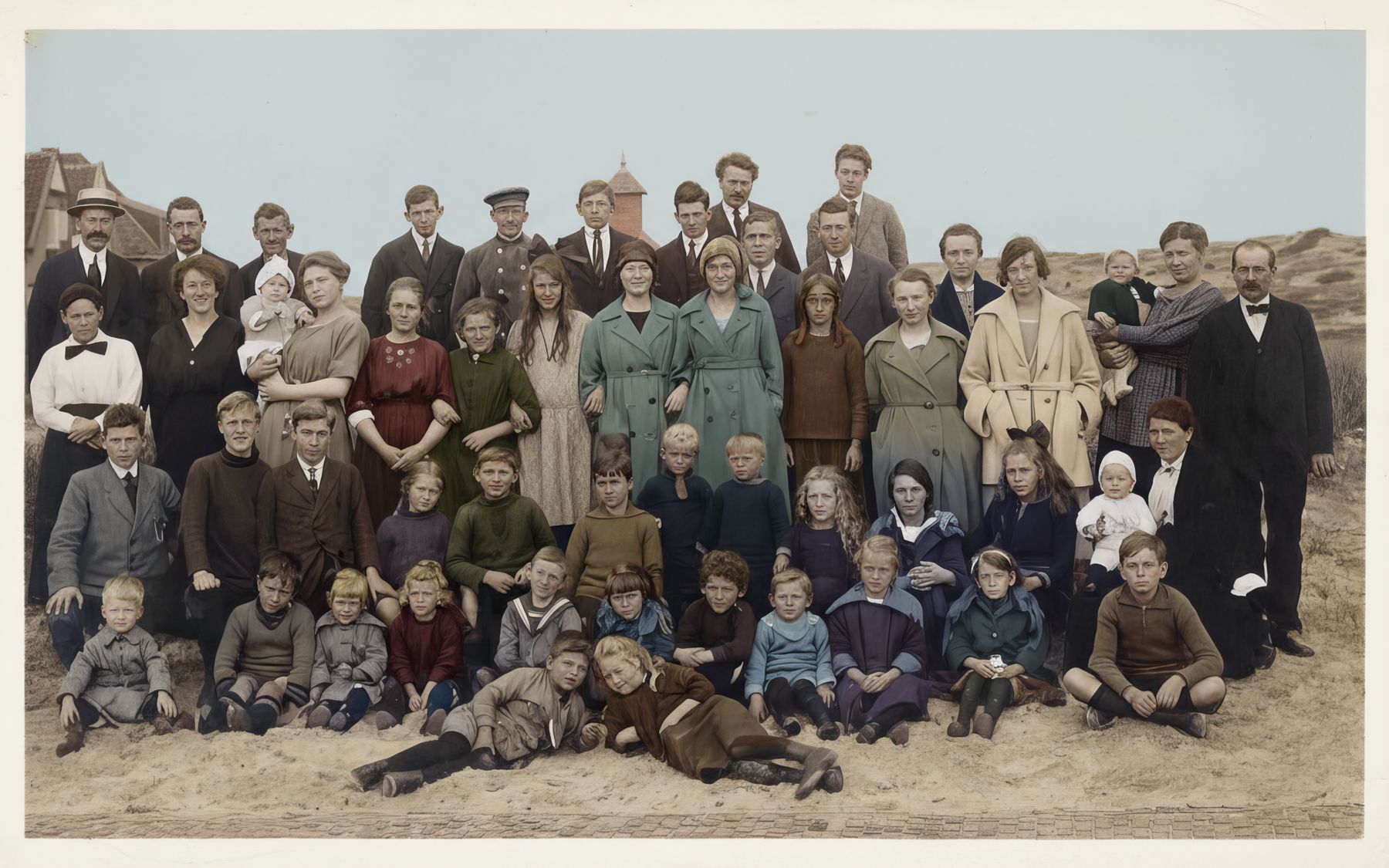
Fifty residents of Bergen aan Zee in 1923. Hover over a face, or tap it, to see the name. All names
Jannie Aardema, Siem Aardema, Ali Dokter, Bertus Dokter, Mevr. Aaf Elders, Pim Elders, Annie Groenland, Cor Groenland, Frans Groenland, Lies Groenland, Piet Groenland, Dirk Haasbroek, Mevr. Cornelia Haasbroek, Nel Haasbroek, Annie Kuitwaard, Ferdinand Kuitwaard, Dik Mosk, Jan Mosk, Lies Mosk, Mevr. Mosk, Cees Nap, Wim Nap, Corrie Ravenhorst, Gijsje Ravenhorst, Mees Ravenhorst, Mevr. Neeltje Ravenhorst, Neeltje Ravenhorst, Thijs Ravenhorst, Dirk Roos, Herman Roos, Cor Schotten, Hans Schotten, Henk Schotten, Jannetje Schotten, Klaas Schotten, Theo Schotten, Wim Schotten, Joop Stekelbos, Piet Stekelbos, Alie Stroomer, Jacob Stroomer, Jan Stroomer, Marie Stroomer, Mevr. Dieuwertje Stroomer, Willem Stroomer, Hans Verwer, Iep Verwer, Jo Westerbeke, Mevr. Westerbeke, Bob Weyhenke, the Weyhenke sisters.
-
1924
“The Netherlands' youngest resort”
Eighteen years after the first stone, Bergen aan Zee is a resort with style, which the press likes to call “the Netherlands' youngest resort”. At beach post 33 three buildings stand out: Hotel Nassau-Bergen right by the sea, Villa Russenduin on a high dune and the Vredeskerkje in the valley between the Zeeweg and the tram line. At Nassau-Bergen guests dance to a New Edison Pathephone, and at Hotel Trianon owner J.A. Verwer puts a radio in the lounge. The village gets six street lamps, and extra trams bring crowds to a big open-air concert with fireworks.
From 1 July 1925 the Badtrein runs: board at 7.30 in the morning in Bergen aan Zee and, without changing, you are in Amsterdam about an hour and ten minutes later. The family can stay by the sea while father goes to the office. The bathing train runs only in July and August.
-
1916–1933
Russenduin, bathing train and Bio holiday home
In 1916 the first stone is laid of Villa Russenduin, for August Janssen, an entrepreneur in mining and in tobacco, coffee and rubber in the Dutch East Indies. He bought 13 hectares of dune from the Van Reenen family for a summer residence shaped like a castle in the Amsterdam School style, and named it after the 1799 battle against the Anglo-Russian army.
On 23 December 1930 the Dutch Cinema Association buys the villa. After a 1932 conversion it becomes the Bio-Vakantieoord, where pale children from the big cities build up their strength with rest, cleanliness and routine. From 1925 a bathing train brings day-trippers straight from Amsterdam, and in summer Bello sometimes carries twenty thousand people a day.
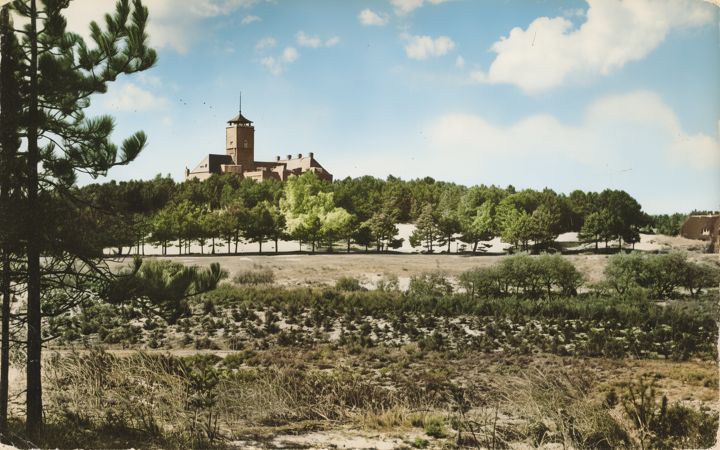
Villa Russenduin above the pines, later the Bio-Vakantieoord and now Landgoed Huize Glory. 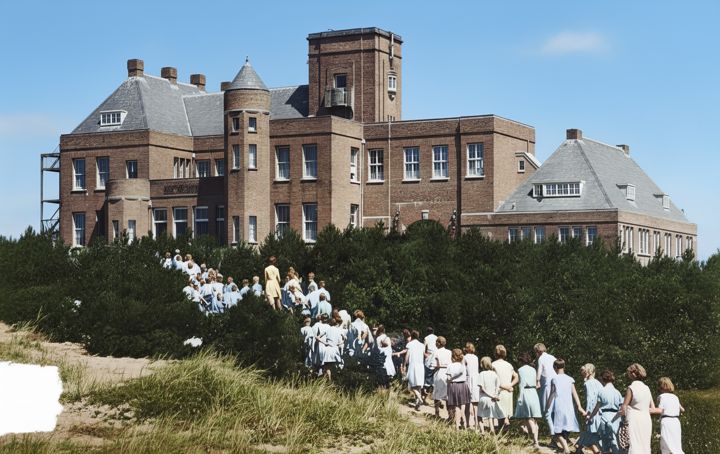
Children on their way to the Bio-Vakantieoord. -
1931
25 years of Bergen aan Zee
The resort's silver jubilee is celebrated across Bergen, with former mayor Jacob van Reenen at its centre. The municipality gives the residents a monumental lantern as a memorial, at the tram stop on the Van der Wijckplein. Bergen aan Zee is more popular than ever: on Whit Monday 1931 17,000 visitors arrive, and on the day of a flower parade Bello once brought 30,000 passengers to Bergen.
According to the Alkmaarsche Courant of 1956, the group photo after the handover shows: in front, the Queen's Commissioner Jhr. Dr. Roëll, with former mayor Jacob van Reenen and former alderman J.W. Macdonald to his right. To the right of the monument, among others, former mayor H.D.A. van Reenen next to C.F. Zeiler and Baron A.L. Taets van Amerongen, former aldermen J. Apeldoorn and C. Bogtman, journalist Dirk Klomp and, far right, the monument's designer, architect Miss Cüffers.
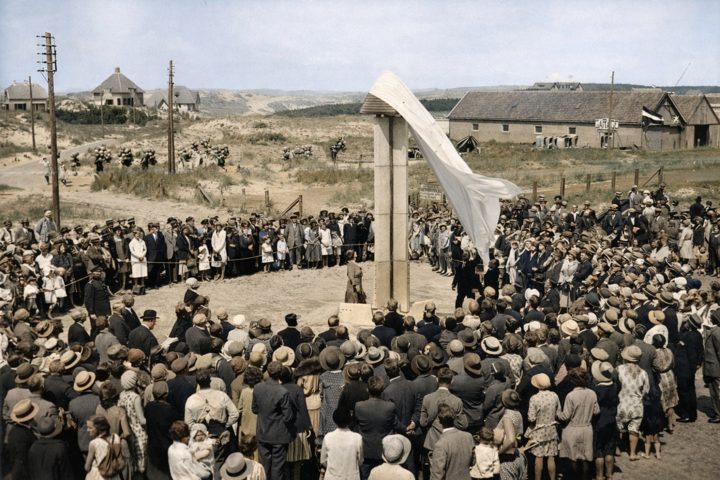
The unveiling of the lantern. 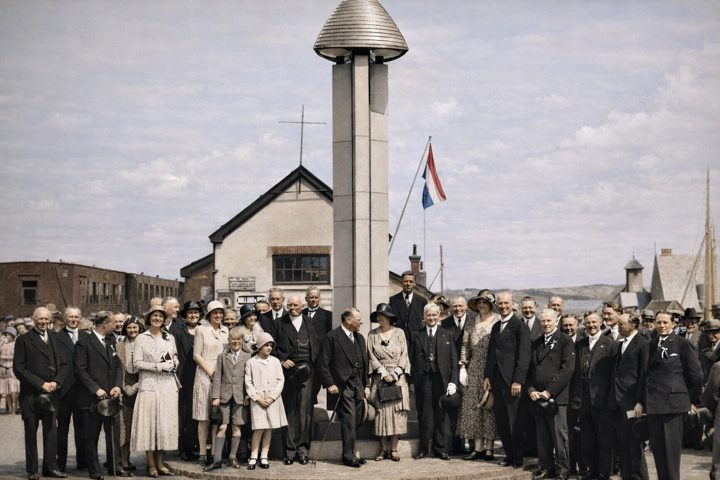
After the handover: Jacob van Reenen (centre, with walking stick) and the guests at the lantern. -
1965
Hotel Prins Maurits renewed
The Stroomer family thoroughly rebuilds the hotel. It reopens in spring 1965, and for decades guests return year after year.
In those years Prins Maurits is also a fixed point for the village itself. Sinterklaas visits all the village children there, one of Bergen aan Zee's two petrol pumps stands at Stroomer's garage, and in summer “Uncle Jackie” delivers gas bottles in a crate on the back of his Norton. In the alley behind the garage is Van den Born's bakery, where the smell of warm bread lingers for hours.
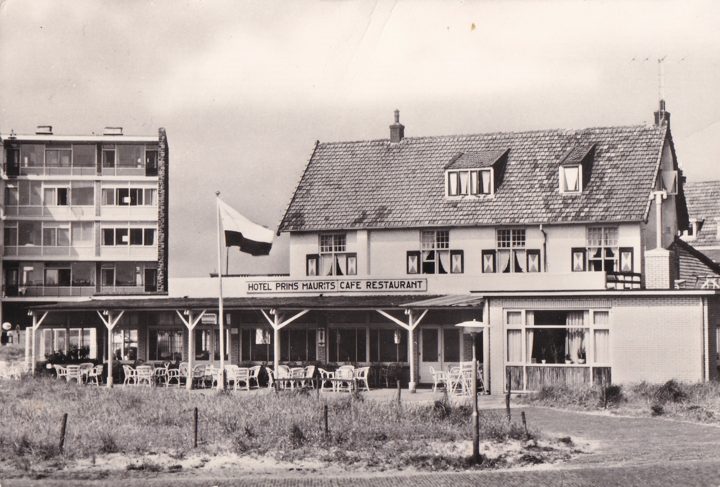
Hotel Prins Maurits around 1960, still the old building with its canopy and terrace. On the left the Alexanderflat. 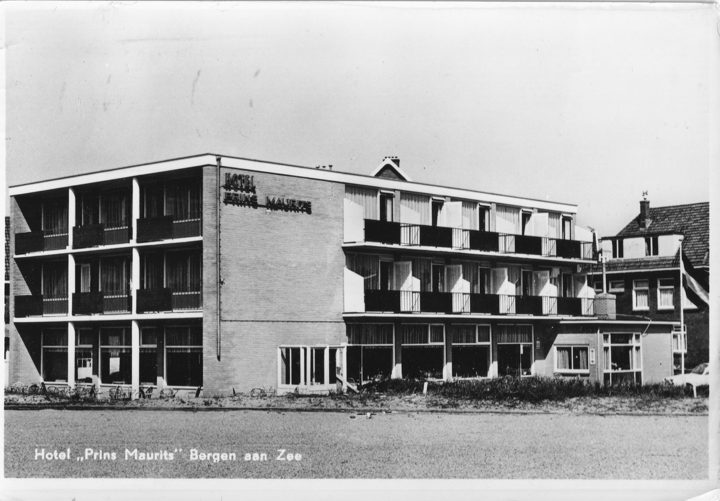
The renewed Hotel Prins Maurits, 1965: three storeys with balconies. The old building can still be seen on the right. -
2022
Strand Residence
Hotel Prins Maurits closes its doors. On its site rises Strand Residence Bergen aan Zee, built by the fourth generation of Stroomers. As much material as possible was reused in the demolition.
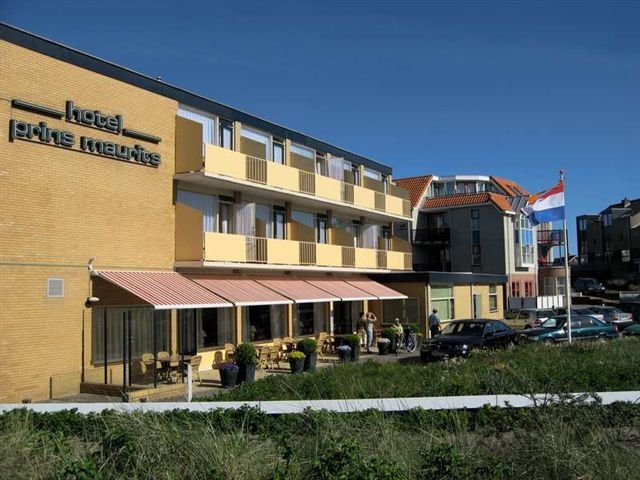
Hotel Prins Maurits in its final years, before it closed in 2022.
Memories of Prins Maurits
Did you ever stay at Prins Maurits, and do you have a photo or story? We would love to hear from you at info@prins-maurits.nl.
The story continues
You can still stay with the Stroomer family. On the Van der Wijckplein stands Wilhelmina, opened in 1949 as a guesthouse-hotel during the years of rebuilding. In that building we now rent out six holiday apartments in Bergen aan Zee, a few minutes from the beach. And on the site of Prins Maurits itself now stands Strand Residence Bergen aan Zee, built by the fourth generation.