A new resort needed rules. As early as 1906 Bergen asked the town of Zandvoort for its bylaw on sea bathing. So rules came in on bathing costumes, which were not to "give offence".
Bathing machines and striped tents
To enter the sea decently, there were bathing machines, some built on the chassis of old army carts. A bathing attendant with a flag and a horn kept watch, and a team of BEM beach workers set out the machines, cabins and chairs every morning. After a swim you could take a shower. Everything was stored in the sheds on the Witteweg, where for years the remains of a land yacht the BEM had built itself also stood.
Around 1920 the bathing machines disappeared and tents arrived. Photos from around 1924 show a tent beach full of identical striped tents. In 1924 the Het Stille Strand society was founded, for simple beach life. A year later the BEM gave it a licence for tents and a shed on three hundred metres of beach north of the Druivesteijnweg. The society still puts up its shed on the northern beach.
A day by the sea
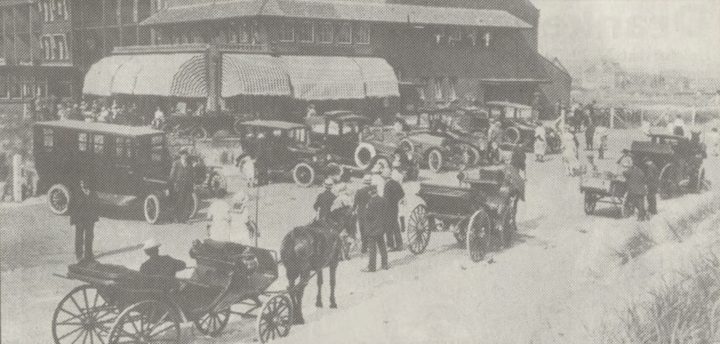
A family renting a cottage in the 1920s kept a fixed rhythm. Father took the tram and train to Amsterdam and came back around half past six. Everyone else went to the beach, spades trailing behind and mother with a cartload of bathing suits and towels. There were three ways down to the beach: south to the bathing-machine beach, in the middle to the tent beach and north to the free beach. At noon everyone went into the sea; in the afternoon there was an hour's rest. Buses needed permission to enter the village, because the Zeeweg was private.
Building sand forts
Every year the BEM organised contests: building sand forts on the beach and a tennis tournament for visitors. For the fort contest you formed a team of eight. Posts stood along the tideline at measured distances, set out by Schotten of the BEM. At the whistle the digging began: a steep side to the sea, a moat around it. The post, as the highest point, had to keep rising with the fort. The tide came in, and the team whose post stood longest won. The prizes were laid out on long tables at Nassau-Bergen: kites and shell boxes.
Beach exercises
In 1938 Miss Van Gulick was hired to lead beach exercises every morning from eleven to twelve. At first the children thought it ridiculous, but as more and more people joined in, young and old, and everyone ended by diving into the sea, it became a splendid novelty. Engel, the bathing attendant from Egmond, kept watch. At low tide you could paddle a canoe out to the wreck of the Ulysses.
In the evening there were walks along the glowing sea, a lantern parade on the Queen's birthday, and Nassau-Bergen held a children's ball. At the end of August everyone took the tram to the fair in Alkmaar. And in winter, when the resort was quiet, the village children put on plays and dressed up.