At the end of August 1945 Bergen aan Zee was released again. Of the 110 pre-war buildings, 45 had gone, including Hotel Nassau-Bergen, villa Ulysses, the post office and the villas on the boulevard. By the end of 1945, 54 people lived here again; by the end of 1948, 214. On 3 June 1946 the tram ran again, and on 2 January 1946 the boulevard was renamed the C.F. Zeilerboulevard. That year Hotel Nassau-Bergen was temporarily housed in villa De Dennen. The boulevard's new route came from the office of Wieger Bruin, who also drew up the village's reconstruction plan. Not everyone was pleased with his plans.
Visitors again
In 1948 the BEM announced in the Badbode that the village was ready: the bunkers were gone from the beach, the buildings repaired, and tennis was being played again in the Parnassiapark. There just wasn't enough accommodation. A year later Pension Wilhelmina opened on the Van der Wijckplein. Hotel Frisia came back as Casa Blanca, Hotel Stroomer as Marconi. Marconi was then the largest building in the village centre.
Where Nassau-Bergen had stood, only the foundations remained, and people simply walked past them on their way to the beach. In 1952 and 1953 the new Nassau-Bergen went up on the site of villa Ulysses. The Zee Aquarium opened in the old cellars in 1954. A year later architect G. Boon won the competition for a hexagonal restaurant above it; Neptunus opened there in 1960.
The village around 1950
Those who grew up here then remember the space above all. The Parkweg was a dead end, Transvaal still untouched dune, and in winter hardly anyone lived on the Parkweg. In summer the regular families came to their second homes. Milkman Hopman, baker Van den Born and the grocers came round by car, and twice a year the coal men hauled their sacks of coke up the dune. There was a nursery class in the basement of Nassau-Bergen.
Flats in the dunes
Around 1956 the village suddenly grew. Neptunus was built, and the Alexanderflat, four storeys high at the start of the boulevard. Coming out of the Vredeskerkje, you saw it rise like a wall between land and sea. Residents called it "dreadful" and "irresponsible" in the paper. In 1958 there was uproar over the Julianaduin, where a block more than eighteen metres high was planned. Residents, the VVV and the Paal 33 beach society objected: visitors came for nature, not housing blocks.
The Engelse Veld stays green
The plans kept coming. In 1966 a high-rise scheme on the Engelse Veld was rejected. In 1974, when the village had about ninety homes and three hundred residents, G.A. van der Veen drew up a plan for five hundred homes on the Engelse Veld, with a school and a village hall. It never went ahead. In 1981 the dunes around the village were permanently designated as nature. The Engelse Veld remains unbuilt to this day.
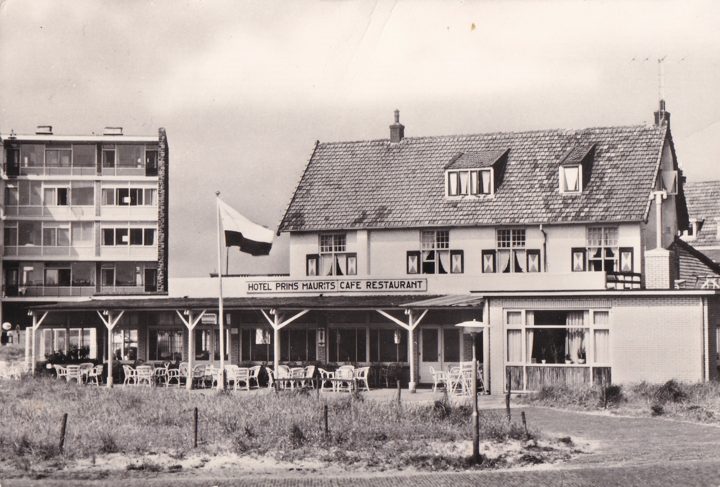
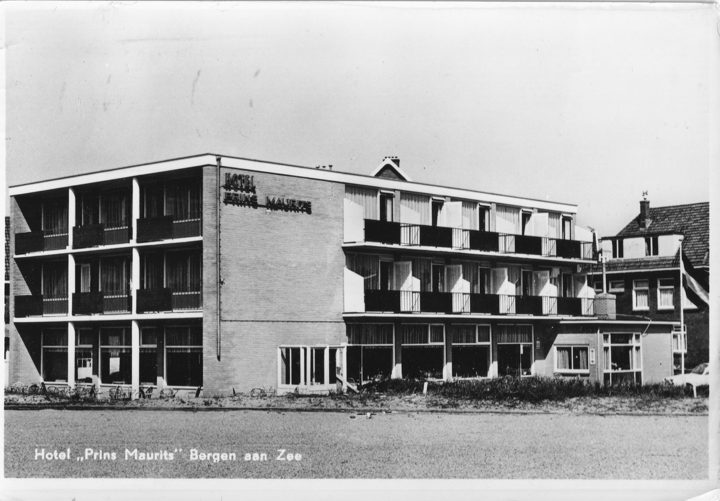
Prins Maurits, meanwhile, carried on. In 1964 and 1965 the hotel was thoroughly renovated, and it reopened in the spring of 1965.