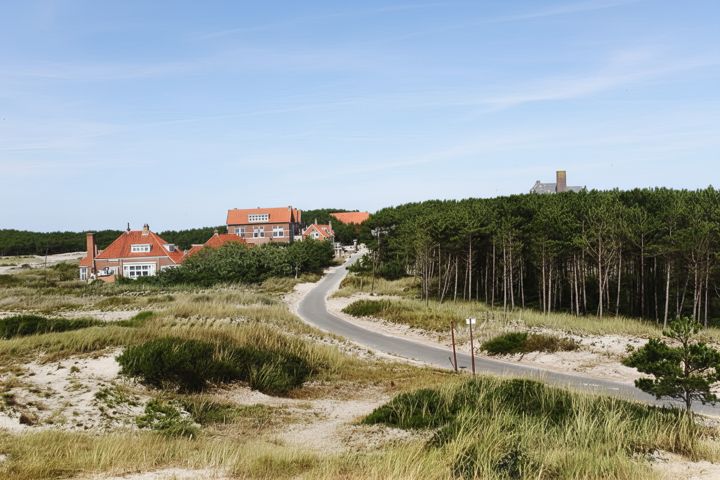
Bergen aan Zee soon also became a place where children came to recover. Around 1900 people had great faith in the healing power of sea air, sun and rest, especially for the pale children of the crowded cities. Mayor Jacob van Reenen gave the land, and three holiday homes went up side by side on the Verspyckweg.
The Zeehuis
The first was the Zeehuis, a convalescent home of the Burgerweeshuis, the civic orphanage of Amsterdam. It was built in 1908 to a design by P. Heyn, who was also the orphanage's building supervisor. It had room for forty to fifty children. To reach the beach the children walked along a narrow brick path, called the Piet Heynweg in 1909 and later the Druivesteijnstraat. In the village everyone called it the "Kloonie path". In 1939 the Zeehuis took in 89 German-Jewish refugee children. In 1959 it closed as a children's home and passed to the NIVON. It has been a provincial monument since 1994.
Voor Jong Nederland
In 1911 the holiday home of the Voor Jong Nederland society opened, designed by A.D.N. van Gendt, for 32 children. Behind it came an open-air rest hall shaped like three-quarters of a circle, designed by G. Arendsen and J.W.F. Hartkamp. The children lay there in bed in the open air for a few hours every day. On the roof terraces they could sunbathe, paid for by the collecting tin. In 1936 a solarium was added behind the house. The rest hall is now a provincial monument.
The Deutsche Hilfsverein
On 18 May 1913 the third home opened, that of the Deutsche Hilfsverein, the German aid society in Amsterdam. It was designed by Vorkink and Wormser, with their typical façades flaring out at the bottom, and took 38 children.
The Bio
The fourth holiday home was not on the Verspyckweg but high on the Russenduin. In 1930 the Dutch cinema association bought the villa that tea merchant August Janssen had built there in 1916–1918. After a conversion it opened in 1933 as the Bio-Vacantieoord, for about a hundred children. The money came from collections in cinemas, after a short film about the Russenduin.
A village full of children
In 1923, 160 children were staying in the holiday homes at once, more than the village had residents. Anyone growing up here in the 1950s saw the homes and the Bio at the end of the Elzenlaan or high on the dune. With better social provision and growing prosperity, the need for holiday homes for city children gradually faded. Most of the buildings are still there, with new uses.