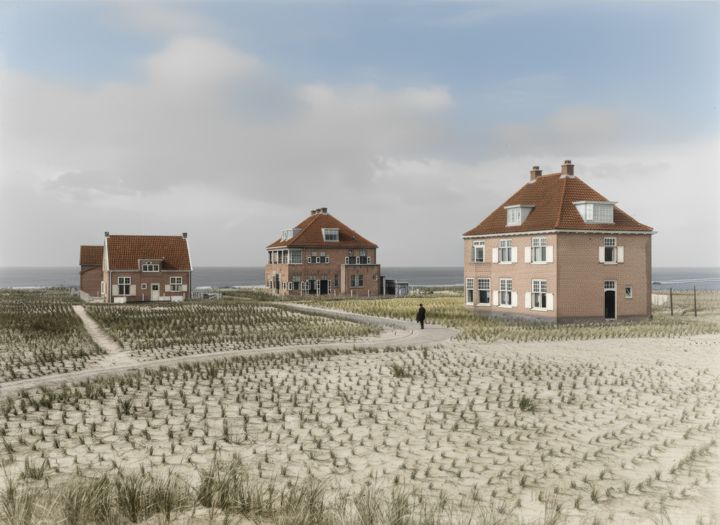
Pre-war Bergen aan Zee took shape in 33 years, from Prins Maurits and villa Ulysses in 1906 to the Flat, Zeldenrust and Duinhorst in 1939. The street plan was by Springer (1907) and Berlage (1909). Within it, everyone built differently. That was exactly what gave the village its charm: no two houses were alike, and almost all of them stood free in the dunes.
The architects
One name runs through the village like a thread: P. Elders, the local architect. Between 1914 and 1939 he designed some thirty of the 110 buildings. Nobody knew better how to build on the front dunes. A close second was the Amsterdam firm of Vorkink and Wormser: ten houses and the children's home of the Deutsche Hilfsverein. You can recognise their houses by façades that flare out at the bottom, giving them a sturdy look. The Bergen architects Wildeboer, Leijen, Van Exter and De Heer-Kloots also built here, and sometimes a builder put up a house on his own account, like Willem Stroomer, who also designed Hotel Dubbel Bakhuis.
Everyone had to deal with architect Wieger Bruin. He chaired the advisory committee on building plans for the North Holland municipalities, and his word was law. The BEM had its say too: land was only sold once it had approved the building plan.
Roofs
The most common roof was the pyramid roof, sloping down on all four sides. Hotel Trianon, Westerlicht, De Wijde Blik and 't Hoge Duin on the Boulevard had one; most of them have gone. 't Sterntje on the Zeeweg, Sandy Corner, Windy Ridge, 't Roefje and De Dennen still stand.
The mansard roof, very common in Bergen itself, was rare by the sea. The post office, De Blinkert and Hotel Dubbel Bakhuis had one. Thatch was more frequent: Aan de Zonzij, Corbenkeebar and of course the Vredeskerkje. There were only a few slate roofs, such as on De Zeedroom on the Boulevard, designed in 1916 by A.H. Wegeriff: white render, red slate tiles, green shutters and decorations of fantastic sea creatures and sea plants.
There were only three flat roofs. De Scholekster on the Boulevard, designed in 1919 by S. de Clercq for the Den Tex family, had pebble-dashed walls and a huge overhang that was badly damaged in a storm during construction. De Longroom on the Patijnstraat had one too. Both were demolished in 1943. De Kubus on the Elzenlaan survived.
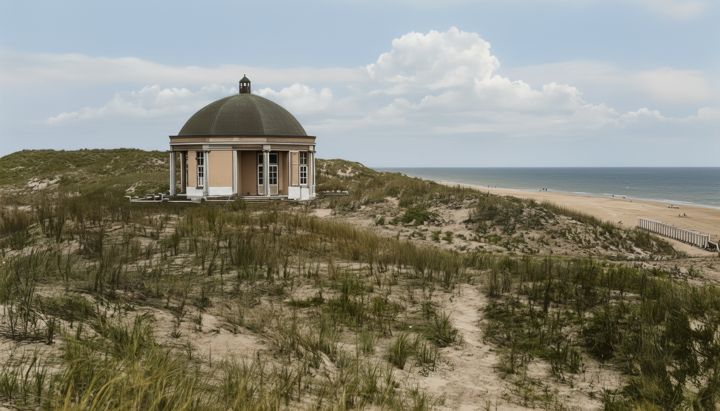
And there was the Sterken ladies' tea pavilion, designed in 1909 by Mr Mauve, with a weather vane shaped like an angel with a trumpet. On 7 November 1942 it was the first building pulled down for the Atlantic Wall.
Names
Almost every house had a name. Plants gave Magnolia, Primula, Duinviooltje, Pirola, De Distel, De Dennen, Parnassia and 't Klaverblad. Birds and sea creatures gave De Scholekster, Albatros, De Dolfijn, De Stormvogel, De Zeemeeuw, De Kievit and De Nachtegaal. The dune appears in 't Hoge Duin, De Duintop, Schelpduin, Duinrode and Duinhorst, the sea in Golfzang, De Zeedroom, De Kokkel, De Zeevonk and De Branding. Sometimes the shape decided the name, as with De Longroom and De Kubus. And villa De Ruyter, built in 1935 for the Verkade family, naturally referred to the Verkade logo.
What remained
Between August and November 1943, 45 of the 110 buildings were demolished, more than forty per cent. The village never really recovered from it. After the war rebuilding went ahead with enthusiasm, but many felt the new villas never recaptured the atmosphere of before.