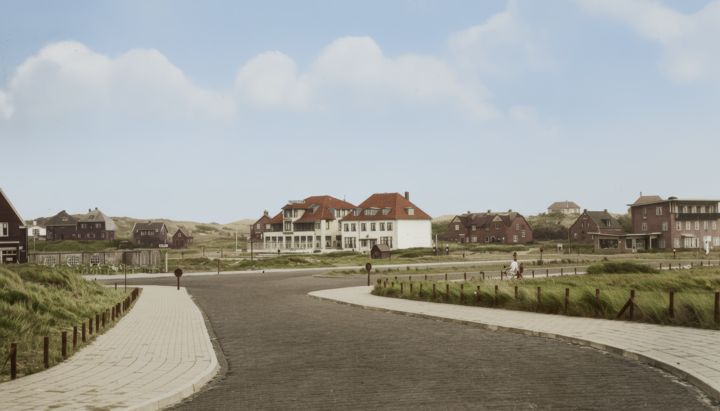
Bergen aan Zee was a project, and the Van Reenen family were, as we would now say, the developers. They owned the dunes, had a clear plan and set up the N.V. Bouw Exploitatie Maatschappij Bergen aan Zee, the BEM, to handle the money and the building. That a woman, Marie van Reenen-Völter, should leave such a mark on a new village was unusual at the time.
First a road, then a farm
First the land had to be made reachable. Work on the Zeeweg started in March 1905 and took about a year. Then building began, modestly at first. The very first building was a farm with a taproom: Prins Maurits. The taproom did so well that the farming was soon dropped and the farm became a café-restaurant. Then came villa Ulysses (1906) and Het Paviljoen (1907) for the Van Reenen family, Hotel Nassau-Bergen and a few guesthouses.
Land for sale
The Van Reenens did not want to build everything themselves. The BEM sold plots for one to five guilders per square metre, depending on location. In 1910 you got 20 per cent off if you built that autumn or the following spring. A sale only went through once the BEM had approved the building plan. In 1910 you could buy the Badbode at A. Passer's in Prins Maurits, along with the song of the Bergenaar, for ten cents.
By 1914 almost forty buildings stood. In 1916 eight were added, including villa Russenduin, the most in a single year. After the First World War sixteen more homes followed until 1921, then things stayed quiet for six years. Between 1928 and 1939 another 35 houses went up. Then the village was "finished": 110 buildings, not counting the sheds on the Witteweg.
From six to a hundred residents
At the end of 1908 two families lived here, six people. By the end of 1910 there were eighteen, by the end of 1912 already 58, and 107 in 1920. In the 1930s the number hovered around a hundred residents and thirty families. The first post office came in 1912, built by Willem Stroomer and open in summer from eight to twelve, two to four and half past five to half past seven. Market gardener Groenland sold vegetables "from clean dune soil", in 1913 D. Roos opened the De Spoorklok bakery, in 1914 Dirk Haasbroek his bookshop in Aurora and in 1916 N. Aardema his grocery in Huize Jeanette. Later came a tobacconist, a garage with livery stable, a fruiterer, a painter and decorator, an art dealer and a dairy with an ice-cream parlour. The one thing the village lacked was a butcher.
Holidaymakers and cars
Letting rooms paid well; it was almost a magic word. In 1923, 293 guests stayed at 43 private addresses, 235 in hotels and guesthouses and 160 children in the holiday homes. Even the village constable let out his house. A guest list from 1912 includes the American writer Upton Sinclair, who stayed with his family at Het Klaverblad.
The car arrived too. Between 1925 and 1929 three car parks were laid out between the Zeeweg and Prins Maurits, and a fourth by the post office in 1933. In 1925 alone, 2,928 cars were parked there. Because the roads were private, the BEM could simply ban parking elsewhere. In winter the middle car park was flooded as an ice rink. Kuitwaard of the garage on the Witteweg ran the car parks; the children loved him because he gave away cigar bands and empty oil tins. In 1927 a three-kilometre cycle path to the sea was built.
So in the 1920s and 1930s Bergen aan Zee was a small but complete village, with more facilities than it would have later. Then came the war, and 45 of the 110 buildings disappeared.