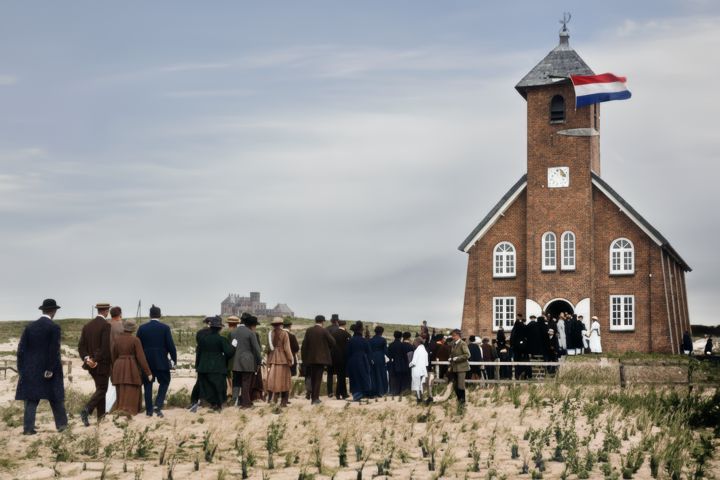
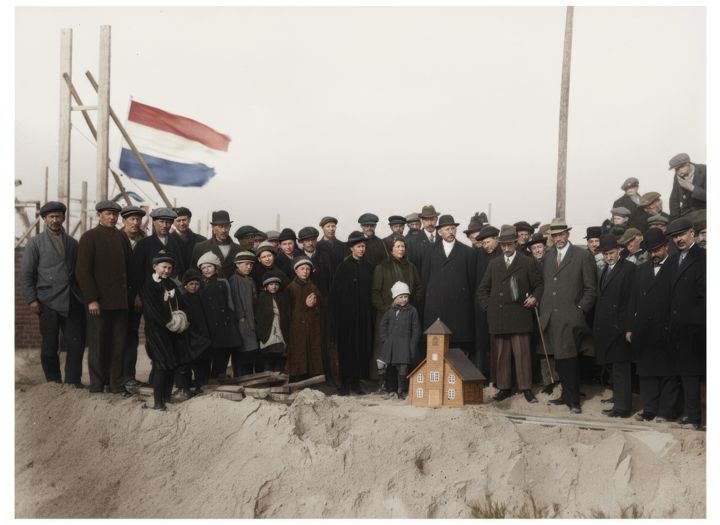
Marie van Reenen-Völter wanted her village to have a church, but a church for everyone. She commissioned the architect Baron Taets van Amerongen and the local architect P. Elders. The builder was Willem Stroomer, who built much of the young village in those same years. The first stone was laid on 9 February 1918, and the church was consecrated on 28 July that year. The ministers Van den Kieboom and Creutzberg led the service, with Mr and Mrs Van Reenen beside them.
A church that blends into the dune
Nave and tower were thatched so that the building merged into the dunes. A stand of pines surrounded the church until the early 1960s. It belonged to no denomination. Marie van Reenen wrote her own liturgy for it, and Mees Ravenhorst, one of the village's first residents, became sexton. The stained-glass windows probably came from the W. Bogtman studio in Haarlem, like those of villa Russenduin. After her death in 1925 the church passed to the Marie Amalie Dorothea Foundation, which still runs it. Later it was named the Vredeskerkje, the little church of peace.
In 1943 much of the village was demolished for the Atlantic Wall. The church was left standing.
Mass on milk churns
Around 1954 the Catholic families in the village wanted their own summer services too. It took some letters to the bishop, but it worked: from then on a priest, curate or missionary said mass there every Sunday. Cor Schotten became sexton. The village boys had to serve as altar boys and practised in the attic above Hopman's dairy shop, with a plank on two milk churns as the altar and squash instead of wine.
The church path and the gate
On the west side, at the end of the Kerkstraat, stands a modest gate with a white wooden fence. Hardly anyone remembered that an identical gate once stood on the east side. A broad path ran round the building, and a narrow brick path led through the Engelse Veld to the corner of the Elzenlaan and the Zeeweg: a church path by the sea. From the 1960s that side fell into ruin, until nothing could be seen of it.
Sexton José Siebers took the initiative to uncover the steps, the path and the gate's foundations. With money from residents, the nature manager PWN and the municipality, and with donated bricks and plants, it was restored. Students from a vocational school in Alkmaar did the brickwork and carpentry and copied the gate on the Kerkstraat. On 25 November 2011 the eastern entrance was reopened with a celebration.
In 2018 the Vredeskerkje turned one hundred.