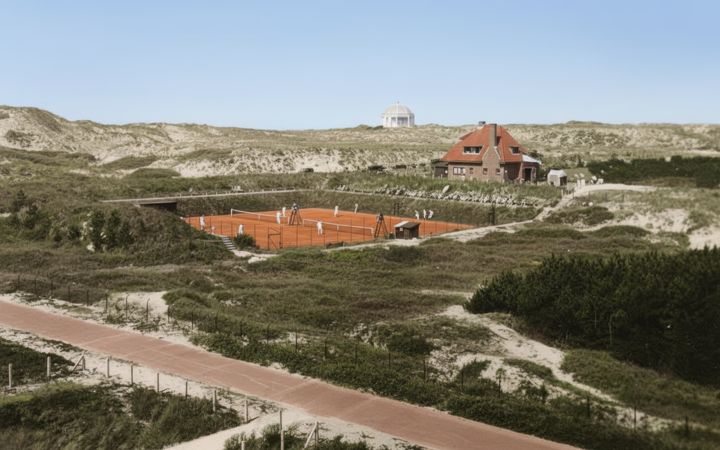
Around 1900 interest in nature was growing in the Netherlands. Heimans and Thijsse wrote their well-known nature books, and in 1905 Natuurmonumenten was founded. Marie van Reenen-Völter was an enthusiast. When landscape architect Leonard Springer designed the Bergen aan Zee villa park in 1907, the village got two parks: a simple pine park in the north, later the Engelse Veld, and in the south, in the large dune valley by villa Ulysses, the Parnassiapark.
A park with everything
The Parnassiapark got just about everything a park of the day could have: a croquet lawn with a shed for the equipment, a copse with a goldfish and duck pond, a rustic wooden bandstand, a pond with a fountain that "really spouted", and a park house with an old-Dutch tea room. Tennis courts followed, with a second double court in August 1922. In 1912 Jac. P. Thijsse himself came to advise on the native planting; a path behind the pond was named the Thijsselaan after him.
Children who played there in the 1920s later remembered the white pebbles on the paths, the playing field, the dovecote, the big pond and the little pond, and the statue of a girl afraid of a frog. In 1936 a large flower show was held by the pond.
The Dune Museum
On 4 July 1914 a museum was added. Builder Willem Stroomer built it for the Van Reenen family: a square building of overlapping timber boards with a thatched pyramid roof crowned by a lantern. Next to it came a botanical garden, in which Thijsse played a big part. Inside were dioramas: mounted plants and animals in front of a painted backdrop by Theo Forrer. In summer fresh plants were put out almost daily, each with its name.
The war ended all that. From 1941 the beach was largely off limits, and in 1942 the mounted animals were used for target practice or carried off. The empty building became a horse stable. Only in 1954 did builder Dick Mosk restore it, with money from the state and the municipality, which became owner of the park and buildings for one guilder. On 2 July 1955 the museum opened for the second time, with the bird collection of its new curator Bob Boersma. It drew 3,000 visitors that season. Adults paid 25 cents, children 10.
Studio and nature centre
When Boersma left in 1962, the collection was scattered among schools. Until 1976 the building was a studio for the artists Kees Jansen and Nico van Stralen. Then the IVN took over. On 30 April 1977 the mayor opened the museum for the third time, now as a nature centre. On 18 May 2001 it reopened, enlarged, under the name Parnassia.