Long before there was a village, a path already led to the sea here. On Blaeu's map of around 1660, a shell track, the Schilp Slagh, runs from the farm De Franschman through the dunes to the beach. At its end stood a few fishermen's huts, a watch house and a fire beacon. That spot now lies under the sea: the coast has retreated some three hundred metres since. Shell fishermen carted their loads along the path to a landing near De Franschman, where the shells went by barge to the lime kilns.
The battle in the dunes
In 1799 that path was fought over. England and Russia had landed in the north of North Holland in August to defeat the pro-French Batavian Republic. Most of the soldiers were Russian. On 19 September there was fighting at Bergen, and again on 2 October, this time mainly in the dunes between the sea and De Franschman. It was a hard, bloody fight. According to tradition, some three thousand dead were buried in a mass grave along the shell track, roughly where the Russenduin lies today. Four days later the invasion army was decisively beaten at Castricum.
The drifting sand kept giving up the dead for years. In March 1800 a few Bergen men were ordered to rebury the bodies that had surfaced in the dunes. Around 1916 Jonkheer Barnaart still found an almost complete skeleton there. The name Russenduin, Russians' Dune, recalls what lies beneath. There has never been a grave monument.
A castle for a tea merchant
In 1913 the whole dune was planted with pines. Three years later August Janssen, a wealthy tea importer from Baarn, bought the Russenduin from the Van Reenen family: almost thirteen hectares, for 46,692 guilders. Janssen had also helped finance Hotel Nassau-Bergen. On 9 September 1916 his daughter Melly laid the first stone of his summer house, designed by the Van Gendt brothers. All the building materials came by tram and had to be hauled up from the station. Because the villa stood higher than the water tower, a special installation was needed to get water up to it. Inside were tile panels and stained-glass windows showing scenes from the battle of 1799.
Janssen had little joy of it. On 10 April 1918, three weeks after moving in, he died. His heirs could not sell the house and it stood empty for years, until his son P.W. Janssen bought it at auction in March 1924.
The Bio
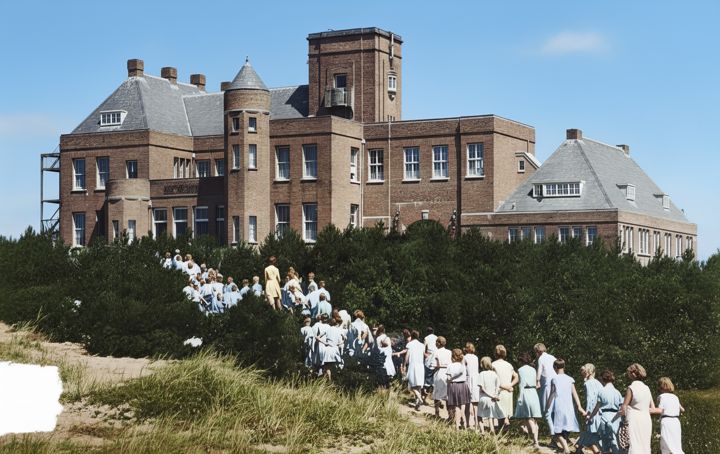
On 23 December 1930 the Bio-Vacantieoord foundation of the Dutch cinema association bought the villa. Architect Harry Elte converted it into a holiday home for about a hundred city children, with an indoor pool. It opened on 1 July 1933. Soon everyone called it "the Bio". The money came from collections in cinemas: after the main feature a short film about the Russenduin was shown and the collecting tins went round.
During the war the tower was raised by seven metres as a lookout post. After the war the house served as a holiday home for many more years, until the need for homes for pale city children faded. The building now belongs to the Verenigingskerk and is called Huize Glory. It has been a national monument since 2000.